This project demonstrates a production-ready automated content pipeline that generates articles and images using AI, orchestrates the workflow with n8n, and publishes everything to WordPress with minimal manual intervention.
Final Article: Building a Content Pipeline That Runs Itself: A Practical Guide to Automation
1. System Architecture Overview
At a high level, this system is built around an orchestrator (n8n) that connects several specialized services: a data source, an AI content generator, multiple image generation models, and the publishing platform. Each component focuses on a single responsibility, while the orchestrator coordinates the full lifecycle from input to publication.
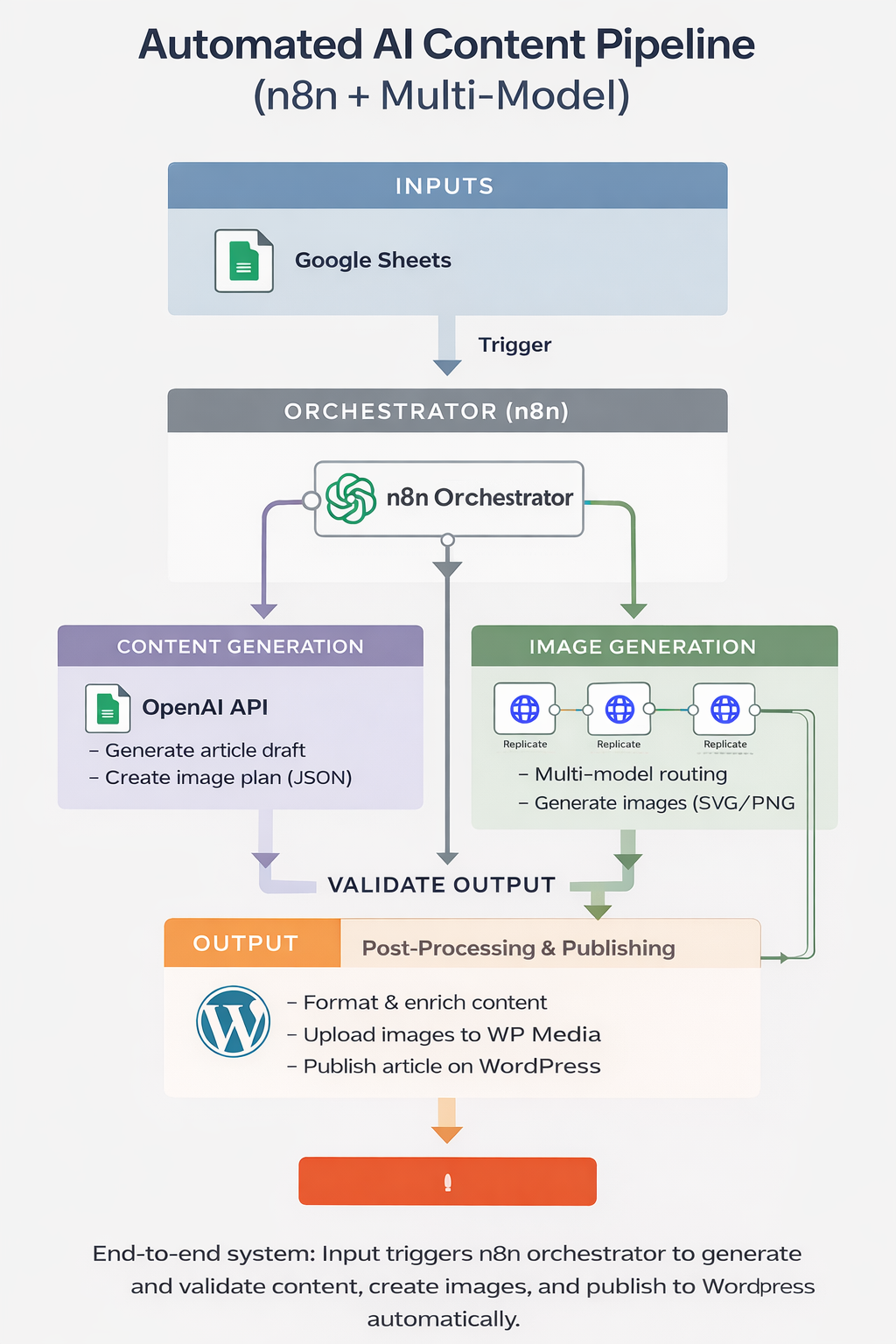
- Trigger / Data Source: Structured input (e.g. Google Sheets or scheduled jobs).
- Orchestrator (n8n): Controls the entire workflow, branching logic, and retries.
- Content Generation: AI generates structured article content.
- Image Generation: Multiple models generate illustrations in parallel.
- Publishing: Final content and images are uploaded to WordPress automatically.
- Status Tracking: Source records are updated for observability and traceability.
2. End-to-End Workflow
Once triggered, the pipeline runs through a fully automated sequence that replaces a traditionally manual, error-prone content production process:
- Trigger from a sheet row or schedule
- Generate structured article content with AI
- Validate and parse the AI output
- Generate images using multiple models
- Process images (resize / convert if needed)
- Publish post and images to WordPress
- Update status and logs
This design turns content production into a repeatable, scalable, and auditable system instead of a one-off manual workflow.
3. Real n8n Implementation
Below is the real production n8n workflow used in this project. It includes looping over batch items, conditional routing between different image models, wait and retry logic for external APIs, and final publishing steps to WordPress.
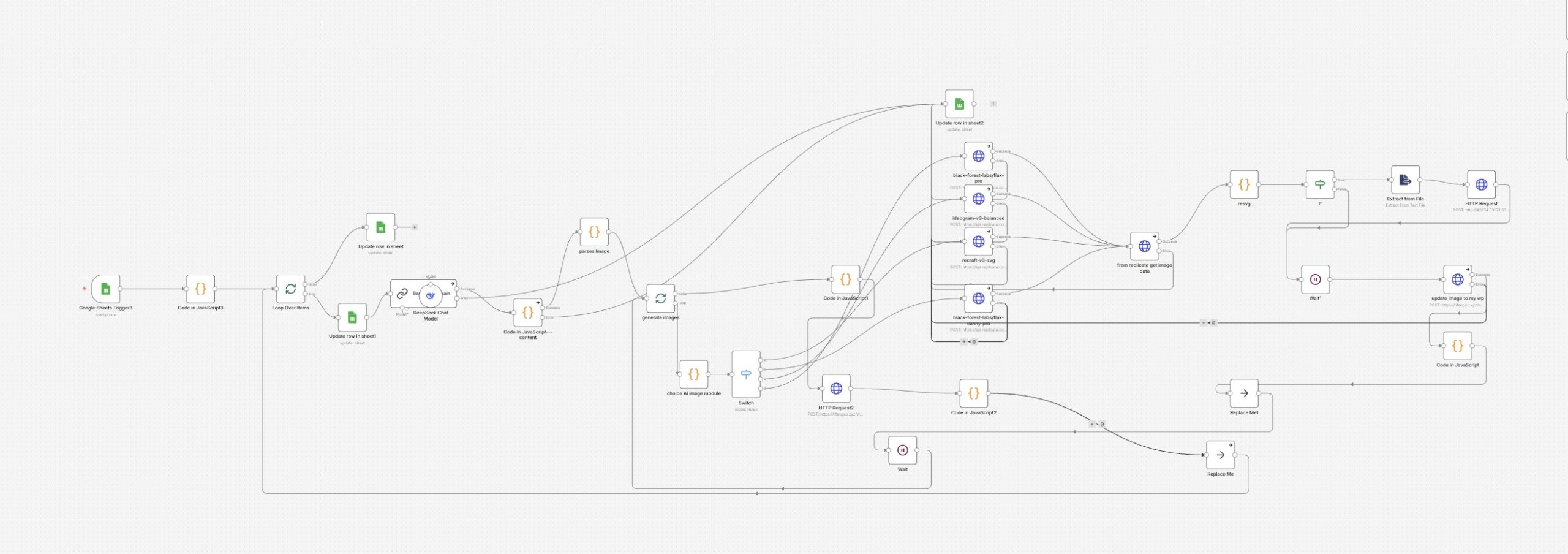
- Supports batch generation via loops
- Uses conditional routing for different image strategies
- Includes wait and retry mechanisms for external APIs
- Keeps the entire process traceable through status updates
4. Why This Architecture Works
- Scalable: Easy to increase volume or add new processing steps
- Modular: AI models or services can be swapped without breaking the system
- Observable: Clear status tracking, logs, and failure points
- Production-ready: Designed for reliability, not just demos or prototypes
5. Conclusion
This project shows how to move from manual content operations to a fully automated, AI-powered publishing pipeline. The same architecture can be adapted for marketing content, documentation systems, knowledge bases, or internal reporting workflows.
If you want to see the result, check out the published article above, or watch the Loom walkthrough for a step-by-step explanation of how the workflow is built and operated.